



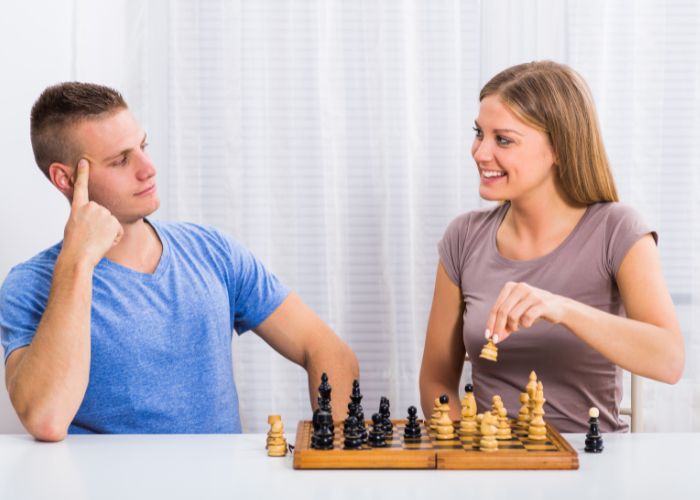
A quiet game of chess can give a couple an easy way to spend meaningful time together without forcing conversation. The board asks for attention, yet it still leaves room for smiles, teasing, silence, and small discoveries about each other. When you are playing chess with your girlfriend, even a short pause between moves can make you notice the person sitting across from you more clearly.
Chess does not need an expensive plan or a crowded place. Two chairs, a board, and enough time to finish a game can be enough.
That simplicity makes it a natural choice for couples who want an evening that feels calm but never empty.
Why Playing Chess With Your Girlfriend Feels Different
A film gives both people the same story, but chess gives each person a part in creating what happens next. Every move changes the situation for both players. That small responsibility keeps attention alive.
You begin to notice how your girlfriend thinks when a position becomes difficult. She notices how you react when a plan disappears. Neither observation has to become serious. The game simply places two personalities in the same little world for a while.
For couples who enjoy playful evenings, romantic games for couples can create a similar feeling. The strongest part is usually not the rules. It is the fact that both people are choosing to participate.
💡 Related - Romantic Date Night Online Games for Long-Distance Couples
A Simple Game Gives You Real Time Together
Many evenings are technically shared while attention remains divided. One person checks messages. The other watches something. Conversation starts and stops because another screen keeps asking for attention.
Playing chess with your girlfriend changes that rhythm because the board keeps drawing both people back. You can still talk, laugh, or take a break, but the activity remains shared. Neither person is merely sitting beside the other.
A 2026 Logitech G survey about couples gaming together surveyed more than 1,500 Australians aged 18 to 45. It found that 44% played video games with their partner occasionally or regularly.
The figure relates to video games instead of chess, but it shows that gaming together is already a normal shared activity for many couples.
Competition Can Show You Another Side of Each Other
Chess creates harmless pressure. A piece is threatened. A plan fails. Someone sees a move too late. These moments are small, yet they can reveal how each person handles frustration and surprise.
Playing chess with your girlfriend may show you that she becomes quieter when she is concentrating. She may learn that you joke when you are nervous about losing. These details are not deep secrets, but they become part of knowing someone well.
The healthiest games leave room for dignity. A win should feel enjoyable without making the other person feel small. A loss should remain a loss on the board, not become evidence about intelligence or worth.
“I used to explain every mistake because I hated looking foolish,” Daniel said. “I relaxed when I realized she cared more about enjoying the game than judging my moves.”
Losing Gracefully Is a Relationship Skill Too
Nobody enjoys losing every time. Still, the way people lose can shape the atmosphere long after the pieces return to the box.
If your girlfriend wins, notice the clever move that got her there. If you win, celebrate without turning the result into a performance. The aim is not to remove competition. The aim is to keep competition from damaging affection.
This kind of restraint belongs outside chess as well. Relationships contain many moments when one person is right, and the other is not. A loving response does not need to make the difference humiliating.
Reading about building harmony in a relationship can help couples think about disagreement in the same way. Connection matters even when two people see the situation differently.
Silence Becomes Comfortable Instead of Awkward
Some couples believe a good date must be filled with conversation. Chess proves that silence can also feel intimate.
During a thoughtful pause, both people can be quiet without wondering what is wrong. The silence has a purpose. It belongs to concentration, and both people understand it.
That can feel especially good after a long day. You may not have enough energy for a deep conversation, yet you may still want closeness. A board game creates a middle ground between constant talking and disappearing into separate screens.
Playing chess with your girlfriend can make those quiet minutes feel shared. You are not withdrawing from each other. You are simply thinking in the same room.
“I used to worry whenever we became quiet together,” Sophie said. “I learned that some silence can feel warm when neither person is trying to escape it.”
The Best Games Leave Room for Laughter
Chess has a serious image, but private games between couples are often full of ridiculous mistakes. A queen disappears because nobody noticed a bishop. A confident attack ends one move later. Someone announces victory and then realizes the king is still in danger.
Those moments deserve laughter.
Couples do not always need complicated entertainment. A game becomes meaningful when both people enjoy taking part, and neither feels responsible for creating a perfect evening.
You can also bring in fun relationship questions between games. One thoughtful or silly question can keep the evening moving after the final piece is placed back in the box.
💁♀ Also read - Funny Couple Card Games to Spice Up Your Date Nights
Make Chess Feel Like a Date
A chessboard alone does not create romance. The atmosphere around it can.
Choose a quiet place where both of you can sit comfortably. Put away work notifications for a while. Add music, a favorite drink, or something small to eat. None of these details needs to look impressive.
Playing chess with your girlfriend becomes more personal when the game carries a few traditions of your own. The winner might choose the next date. The loser might choose dessert. A captured queen could earn a sincere compliment instead of a dramatic celebration.
If you want more ways to notice how each person receives affection, a love language quiz for couples can give you ideas for small rewards that feel personal.
The important rule is that romance should never become pressure. A game is enjoyable because both people are free to relax inside it.
Do Not Turn Teaching Into Showing Off
Sometimes one person already knows chess, and the other is learning. This can be charming, but only when the stronger player remembers that a lesson is not an exhibition.
Explain the rules clearly. Let your girlfriend think without correcting every move before she makes it. If she asks for advice, give enough to help without playing the game for her.
The same applies when she is the stronger player. Being taught by someone you love can feel intimate when patience is present. It becomes irritating when every mistake receives a lecture.
The game should make both people want another round. If one person leaves feeling embarrassed, the lesson has failed even if the chess advice was technically correct.
Ask Better Questions Between Moves
The pauses in chess are useful because conversation can enter without becoming the entire purpose of the evening. You can ask about her week while resetting the pieces. She can ask what you have been thinking about while you decide who plays white.
These questions do not need to be heavy. Ask what made her laugh recently. Ask which trip she would repeat tomorrow. Ask what small thing she wants more of this month.
For deeper evenings, questions that build connection can help you move beyond routine conversation without making the night feel like an interview.
A good question should feel like an invitation. It gives the other person room to answer honestly and at their own pace.
Small Rituals Become Shared Memories
Relationships often collect their meaning through repeated ordinary moments. A particular café becomes yours. Sunday mornings develop their own rhythm. A song becomes attached to a season of your life together.
Chess can become one of those rituals.
Maybe you play every Friday after dinner. Maybe you keep a running score for a month. Maybe the winner signs the date beneath the board. The ritual does not need to be elaborate because repetition gives it meaning.
Small traditions also sit naturally beside thoughtful romantic gestures. A handwritten note beside the chessboard can feel more personal than a costly plan made without attention.
“I remember the games I lost less than the nights themselves,” Oliver said. “I remember her laughing, the music behind us, and how ordinary everything felt in the best way.”
Know When to Stop Competing
Not every evening is right for competition. One person may be tired, distracted, or already carrying frustration from the day. Starting a difficult game in that mood can create tension that has little to do with chess.
Notice the atmosphere before beginning. If one of you is not interested, choose something gentler. Love does not become stronger because somebody agreed reluctantly.
You can also play cooperatively by solving chess puzzles together. That changes the board from a contest into a shared problem. Both people look for the answer on the same side.
Chess works best when the game serves the relationship instead of becoming more important than the mood between you.
What Chess Can Teach Without Pretending It Is Life
It is tempting to turn chess into a grand metaphor for love. Real relationships are far less orderly. People cannot be reduced to pieces, and affection is not a strategy for defeating someone.
Still, chess can quietly reward habits that relationships also need. Patience matters. Attention matters. A rushed reaction can create unnecessary trouble. Admitting that a plan was wrong can save the position.
The lesson is simple: two people learn to pause, observe, and move forward together.
Recommended read - Fun Games for Couples to Play Together With a Twist of Laughter
Simple Moments That Bring You Closer
Playing chess with your girlfriend can make a relationship feel stronger because it gives both of you a simple place to practice attention, patience, humor, and respect. It will not solve serious problems, and no board game should be asked to carry that weight. What it can do is create an hour where two people look at each other, share the same activity, laugh at mistakes, accept a loss, and enjoy a win without cruelty.
Those ordinary evenings often become meaningful because nobody was trying to make them important. You were simply there together, one move at a time. ♟️